
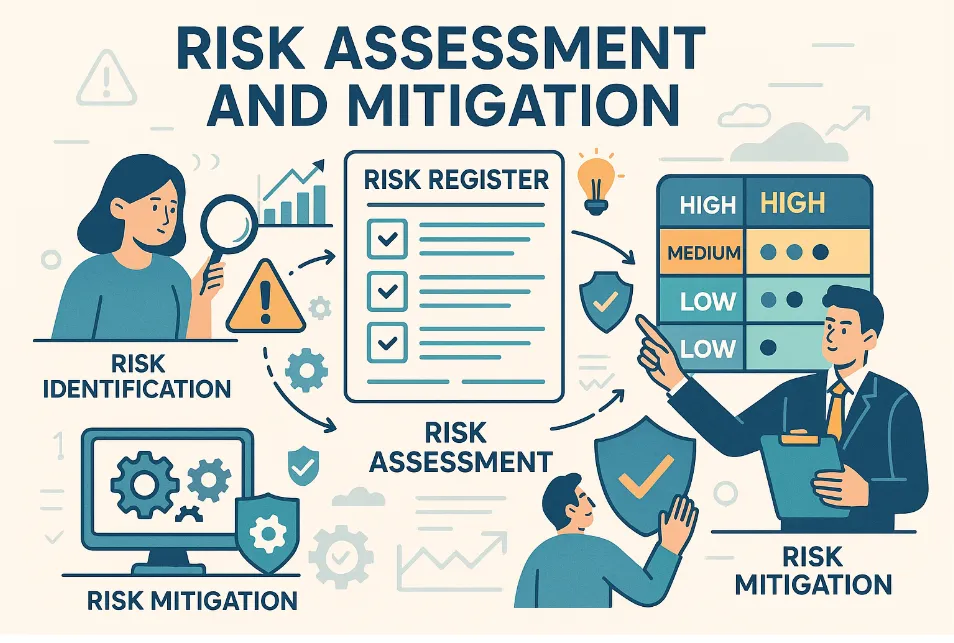
In the dynamic world of Fintech production support and application maintenance, risk management is not just a best practice—it’s essential. As systems become more complex and service expectations rise, a structured risk management strategy is critical to ensure application stability, SLA adherence, and business continuity. This guide explains real-world risks, their assessment, and industry-standard mitigation strategies for Fintech application support environments.
Target Audience: IT support teams, project managers, DevOps engineers, business stakeholders, and risk management professionals.
What is Risk in Application Support?
In production/application support for financial systems, risks are any uncertain events that may negatively impact application performance, availability, data integrity, or customer satisfaction. They can arise from infrastructure issues, software bugs, human error, or third-party dependencies.
Key Categories of Risk in Fintech Application Support
- Operational Risks
- System-generated alerts due to process or job failures
- Manual checks due to incomplete automation
- Outages from software process crashes or database issues
- Data Risks
- Delayed or missing data (e.g., trades, positions)
- Data quality discrepancies impacting reports and dashboards
- Performance Risks
- Slow report generation due to large DB queries
- Batch processing delays requiring manual intervention
- Dependency Risks
- Failures due to upstream/downstream application issues
- SLA breaches triggered by external service delays
- Resource Risks
- Inefficient ticket triaging between L1 and L2
- Knowledge gaps for complex client-specific queries
- Maintenance Risks
- Issues during DB server migration or patching
- Coordination lapses between app, infra, and DBA teams
Common Risk Indicators
| Metric | Indicator of Risk |
|---|---|
| SLA Breaches/Near Misses | Process inefficiencies or dependency issues |
| MTTR > Threshold | Poor root cause identification or resolution delays |
| Tickets Reopened | Incomplete fixes or knowledge gaps |
| High Manual Effort | Lack of automation leading to burnout and errors |
| Frequent Outages | Underlying architectural or deployment issues |
Risk Register: A Living Risk Log
A Risk Register captures and tracks risks over the project lifecycle, especially those with a risk score ≥ 6. It includes:
- Risk Description
- Type: External/Internal/Operational
- Probability & Impact
- Risk Score = Probability × Effect
- Mitigation Plan
- Contingency Plan
- Status (Open/Closed/Mitigated)
Example:
| Risk | Type | Probability | Impact | Score | Strategy |
|---|---|---|---|---|---|
| Job Execution Failures | Operational | 2 (Medium) | 2 (Major) | 4 | Automate alert handling and add fallback mechanism |
| DB Server Overload | Infrastructure | 3 (High) | 2 (Major) | 6 | Plan DB migration proactively and monitor trade volume |
Risk Assessment Metrics and KPIs
To maintain service excellence, the following risk-related metrics are crucial:
➤ SLA Compliance %
- Formula: (Met SLAs / Total Tickets) × 100
- Helps evaluate team performance and responsiveness.
➤ Mean Time to Resolve (MTTR)
- Formula: Total Resolution Time / Total Requests
- Indicates how quickly your team fixes issues.
➤ % Rework Effort
- Formula: (Rework Effort / Total Effort) × 100
- High values indicate recurring or unresolved problems.
➤ Ticket Escalation Rates (L1 → L2 → L3)
- Helps identify knowledge or documentation gaps.
➤ Sigma Metrics (Yield & Quality)
- Yield = 1 - (Defects / Opportunities)
- Sigma = NORMSINV(1 - Yield) + 1.5
- Provides Six Sigma-based quality insights.
Risk Mitigation and Strategy Framework
1. Risk Identification
Use production metrics, outage reports, change logs, and stakeholder feedback to log new risks.
2. Risk Categorization
Group risks into logical categories (e.g., application, infrastructure, data, external dependency).
3. Risk Scoring Matrix
Based on:
- Probability: Low (1), Medium (2), High (3)
- Effect: Less Significant (0) → Catastrophic (3)
Risks with score ≥ 6 must be tracked.
Score ≥ 8 needs a mitigation plan.
Score ≥ 24 requires both mitigation and contingency plans.
⚙️ Risk Response Strategies
✅ Risk Mitigation (Proactive)
- Automate Manual Checks: Free up support resources and reduce errors
- Implement Retry Logic: For transient upstream/downstream issues
- Database Tuning: Optimize stored procedures and indexing
- Alert Optimization: Suppress non-critical alerts to focus on real risks
Risk Contingency (Reactive)
- Fallback to UAT Environment during outages
- DB Migration Plans for high-volume accounts
- Manual Workarounds when automation fails
Risk Avoidance
- Conduct impact analysis before any infra change
- Improve knowledge transfer and documentation to prevent L1→L2 escalations
Risk Acceptance
- For low-impact or infrequent risks, plan passive monitoring and review quarterly.
Practical Learning: How to Apply This
- Build a Custom Risk Register Template
- Include columns for scoring, mitigation, and owner accountability.
- Review Risk During Weekly Stand-Ups
- Keep risks visible and continuously updated.
- Involve All Stakeholders
- Include Dev, DBA, business users in risk planning.
- Track Effort vs. Outcome
- Identify automation ROI and document learnings.
- Use RCA (Root Cause Analysis) for Recurring Risks
- Apply 5-Whys or Fishbone Diagrams for deeper insights.
Areas for Optimization in Production Support
| Optimization Area | Description | Benefits |
|---|---|---|
| Manual Task Automation | Reduce routine checks and data validations | Improves efficiency by 30–40% |
| Alert Review & Tuning | Prioritize high-impact alerts | Reduces noise and improves MTTR |
| Knowledge Base Expansion | Better documentation for known issues | Reduces escalations to L2 |
| Monitoring Enhancements | Add metrics-based dashboards | Enables early warning for outages |
| DB Maintenance Automation | Scripted migration & backup tools | Reduces downtime and human error |
Final Thoughts
Effective risk management in Fintech support hinges on proactive planning, measurable metrics, and continuous learning. With well-maintained risk registers, structured mitigation plans, and a focus on automation, teams can ensure high system availability, user satisfaction, and business continuity.
Remember: Every risk avoided, mitigated, or accepted contributes to more stable, secure, and scalable financial systems.