
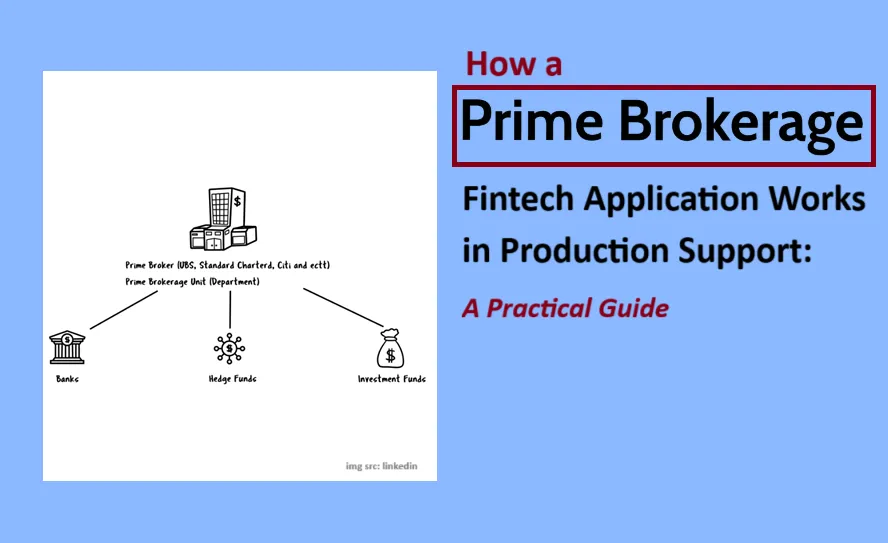
How a Prime Brokerage Fintech Application Works in Production Support: A Practical Guide
In the world of financial technology (fintech), Prime Brokerage (PB) applications form the backbone of services offered to hedge funds and institutional investors. These services range from trade execution and custody to portfolio accounting, cash management, and fund performance tracking.
In this article, we’ll dive into how Prime Brokerage applications function in production and application support, using practical examples. Whether you're a beginner in fintech or a support engineer looking to level up, this comprehensive guide will walk you through:
- Core systems and components
- Real-world issues
- User queries
- Database and infrastructure dependencies
- Technical skills required
- Transition and team dynamics
What is Prime Brokerage in a Fintech Context?
Prime Brokerage provides institutional clients with a suite of services, including:
- Securities lending
- Margin financing
- Trade settlement
- Reporting and custody
- Portfolio and performance analytics
Supporting such an ecosystem involves critical application support, often split across accounting, fund services, custody, and treasury functions.
Core Applications in Prime Brokerage Support
Let’s start by understanding the key systems supported in a typical PB environment:
1. Portfolio Accounting & Reporting Systems
- MSPA (Portfolio Accounting): Central to trade and position calculations. Used by both fund services and PB clients.
- G3 Max: Used for custodial reporting, tracking all asset classes across PB accounts.
- CCAR: Handles cost basis and 1099 tax reporting.
- TLP: Deals with cash log processing for proprietary traders.
2. Fund Services Applications
- MSPM: Performance analytics.
- MSGR: Reconciliation system.
- NSAT, TP+, NTAR: Fund-specific utilities.
- All require batch management, data troubleshooting, and script automation.
Key Responsibilities in Production/Application Support
Application support in Prime Brokerage is categorized into three main areas:
1. Batch Support & Job Failures
Batch failures are among the most common and high-priority issues in production environments:
- Portfolio Not Complete: In MSPA, large or complex portfolios can fail during batch processing. Manual intervention or custom SQL queries may be needed to complete or restart them.
- Database Performance Issues: Sometimes Sybase databases slow down. Support engineers may need to kill slow queries, optimize stored procedures, or offload accounts to different servers.
- Incorrect Stored Procedures: Fixing these involves deep understanding of Sybase DB and business logic.
✅ Tools involved: Autosys, Sybase 12.5+, SQL scripts, Unix shell scripting
2. Handling User Queries
Support teams often deal with front-office queries, which can get complex:
- Incorrect Positions or Missing Trades: Users may report incorrect positions. Analysts need to trace trade flow, reconcile data between systems, and fix any gaps. This requires complex DB querying and understanding of trade lifecycle.
- Requests from Reps or Reconciliation Teams: Fund services teams across time zones may escalate issues that need immediate data validation or corrections.
Key challenge: Balance speed and accuracy under pressure.
3. Database & System Maintenance
With 60+ databases across 20+ servers, maintaining system health is no small feat:
- Server Load Balancing: Accounts processing 20,000+ trades may slow the system. Teams may migrate portfolios to different servers 5–6 times/year.
- Weekend Maintenance: Includes indexing, upgrades, and archival. Sybase is often the DB of choice, with upgrade plans in motion.
- DB Architecture Skills: DB-level planning and query tuning are crucial here.
Tech involved: Sybase, DB2, Linux, backup/restore strategies
Real-Time Support: Fund Services Use Case
Support teams are often involved in:
- Batch issue resolution
- Query analysis
- Scripting to reduce manual effort
- Turnover management and sign-offs
- Monitoring host/infrastructure health
- Change management and release coordination
The focus is not just on firefighting, but on system improvement—e.g., moving batch releases earlier from 4 AM to 1 AM NY time through optimization.
Technology Stack & Skill Requirements
To succeed in PB application support, you need a hybrid of technical and business knowledge:
Tech Stack
- Databases: Sybase, DB2, sometimes Mainframe/CICS
- Scripting: Unix Shell, Perl
- Scheduling Tools: Autosys
- Languages: Java (for mid-tier support)
- Messaging: MQ for integration between systems
- Infra Knowledge: Web infra, firewall/security layers
Business Skills
- Portfolio accounting
- Securities lending and repo workflows
- Fund performance metrics
- Cost basis accounting and tax implications
⚠️ Common Production Issues (and How They’re Handled)
| Issue Type | Example | Resolution |
|---|---|---|
| Batch failure | Portfolio not completing in MSPA | Manual intervention, restart, query logs |
| Trade missing | Trade X not reflecting in Fund Services | Trace trade flow, check MSGR or MSPM |
| DB slowdown | Report taking 30+ mins | Kill long-running queries, index tuning |
| Infra failure | Host down or service unreachable | Alert infra team, coordinate failover |
| Incorrect position | Report shows wrong quantity for equity | Backtrack in G3 Max, check trade execution path |
| Stored procedure bug | Returns wrong calculation in MSPA | Fix and deploy corrected stored procedure |
| Turnover issue | Batch turnover not tested | Add test coverage, seek approval before release |
Transition & Team Dynamics
The biggest transition risk in PB systems is knowledge retention:
- Teams have been embedded for 8+ years; any transition needs to be gradual and modular.
- Suggested transition order:
- Cash Management & Treasury
- Accounting & Custody
- Fund Services
✔️ Rebadging internal talent and documenting tribal knowledge are essential.
Learning Path for Fintech Professionals
If you’re looking to enter or grow in Prime Brokerage application support, here’s a step-by-step roadmap:
- Master SQL (Sybase, DB2): Start with position/trade queries.
- Learn Autosys: Understand how jobs are scheduled, monitored, and recovered.
- Scripting (Unix/Perl): Automate manual jobs, parse logs.
- Portfolio Accounting Basics: Learn NAV, trade lifecycle, reconciliation.
- Infra Concepts: Web services, firewall rules, server migration techniques.
The Operational Mechanics and Strategic Value of Prime of Prime Relationships
While our primary focus has been on the simplified schematic of margin-based Prime of Prime (PoP) models, it's essential to layer in the strategic and operational nuances that underscore why institutions choose PoPs over Tier 1 Prime Brokers (PBs) — and how PoPs manage risk, liquidity, and execution with precision.
Why Most Brokers Avoid Tier 1 Prime Brokers (Despite the Prestige)
On paper, working directly with Tier 1 Prime Brokers like UBS, Citi, or Deutsche Bank may seem ideal. However, in practice, entry barriers and long-term sustainability make this route impractical for the vast majority of firms:
- High Capital Requirements: Opening an account with a Tier 1 PB often requires $2–30 million in non-client liquid assets.
- Prohibitive Onboarding Timelines: Legal and compliance vetting can stretch over 6 months, even for licensed entities.
- Strict Trade Size Minimums: Minimum trade sizes of 2–3 lots due to the reporting overhead (CLS Bank, regulatory compliance).
- Limited Leverage: Leverage rarely exceeds 1:33, and can drop to 1:2 if the PB risk desk flags your trading profile.
These constraints create a capital efficiency dilemma: unless you’re moving $30B+ monthly and have deep institutional infrastructure, you're unlikely to benefit from direct PB access.
The Prime of Prime (PoP) as a Critical Infrastructure Layer
A licensed PoP serves as the middle-layer enabler — allowing brokers, hedge funds, and even sophisticated individuals to access institutional liquidity without the burdens of direct Tier 1 PB relationships.
But this access isn't free — and that's where understanding the margin-based model is crucial.
Key Revenue Streams of a PoP:
- Client Commissions: Volume-based charges, often wrapped into spreads or added transparently.
- Liquidity Provision: Acting as a market maker for clients while hedging in institutional venues.
- Spread Management: PoPs carefully manage spread markups depending on routing decisions and client volume.
Real-World Insight: If a PoP advertises 0.1 pip EUR/USD spreads with no commission, it's highly likely they are internalizing your flow (i.e., not routing to the interbank market) — exposing you to potential conflict of interest.
How PoPs Manage Margin-Based Execution in Practice
Here's a simplified schematic breakdown tied to your original article:
- Client Margin Deposit: You, as a client (broker/fund), post margin with the PoP. This becomes your trading capital.
- PoP Aggregator Technology: Using FIX API, the PoP connects to multiple Tier 1 LPs (via their PB credit lines) and creates a deep, aggregated book.
- Smart Order Routing: Orders are routed based on price, latency, volume, and internal PoP risk limits.
- Credit & Risk Checks: Before execution, a risk module checks if your margin covers the required exposure, factoring in leverage and net open positions.
- Trade Execution & Settlement: The PoP may either:
- A) STP your trades to institutional venues, or
- B) Internalize them to optimize P&L and latency, assuming your flow isn’t adverse.
Strategic Decision Matrix: Should You Use a PoP?
| Criteria | Direct PB | Prime of Prime |
|---|---|---|
| Minimum Capital | $2M–$30M | $50k–$250k |
| Setup Time | 6–9 months | 2–6 weeks |
| Platform/Infrastructure | Must Build | Often Provided |
| Leverage | 1:33 Max | Up to 1:100 (variable) |
| Monthly Minimum Fees | ~$10k | $1k–$5k typical |
| FIX API Access | Required | Optional |
| Internalization of Flow | No | Depends on PoP |
| Best Use Case | Tier 1 Funds | Brokerages, Funds, Elective Pros |
Bonus Insight: PoP Models and Regulatory Arbitrage
Many PoPs operate under regulatory frameworks like FCA, ASIC, or CySEC, giving them jurisdictional flexibility. This also allows clients to choose execution models (A-book, B-book, or hybrid) aligned with their risk appetite, margin preferences, and regulatory obligations.
Closing the Loop with Margin Models
To bring it full circle: PoP firms essentially create a margin-based ecosystem where smaller firms can act with institutional precision, without holding institutional balance sheets.
Margin is not just a leverage figure here — it’s the backbone of trust, the basis for credit limits, and the first line of defense in risk management for the PoP itself.
Final Thoughts: Why Prime Brokerage Support Matters
Prime Brokerage systems are mission-critical to global capital markets. Supporting these systems isn’t just about writing scripts or restarting jobs—it’s about ensuring trust and transparency for institutional clients managing billions.
Whether you’re an L2 application support analyst or a developer transitioning into production support, mastering these systems offers both career growth and deep financial knowledge.
FAQs
Q1: Is coding knowledge mandatory?
➡️ Yes, for automation and debugging. SQL, Shell scripting, and Perl are key.
Q2: Do you need to understand financial products?
➡️ Absolutely. Understanding equities, FX, derivatives, and cost basis helps resolve user issues effectively.
Q3: Is Prime Brokerage support stressful?
➡️ It can be, especially during month-end or quarter-end, but strong teamwork and tools help.